Kakobuy's intake of a self-bought box, from signature to ziplock bag
Kakobuy publishes its intake rule for transit parcels in two help articles, 52 and 95. This page walks through it in the order the warehouse works, with the original sentences where the wording matters.
Damaged outer packaging and the refusal to sign
Rule 1 is the shortest of the four. Kakobuy will not sign for your parcel if it arrives with damaged packaging, or if it does not match the warehouse's signing standard. The article does not publish that standard in more detail, so treat any crushed corner, split seam or heavy re-taping as a risk.
Most of this is settled before the parcel leaves the seller. A seller who ships sneakers in a bare shoe box, or a coat in a thin mailing bag, is shipping the outer packaging as well as the goods. If a listing's reviews or photos show flimsy packaging, ask the seller in chat for an outer carton before they ship.
The same article sets the clock for the domestic leg: normally three to five days to reach the Xiamen warehouse. If you still cannot see the parcel on Kakobuy after five days, contact your local carrier first, then Kakobuy customer service.
The prohibited-goods look after signing
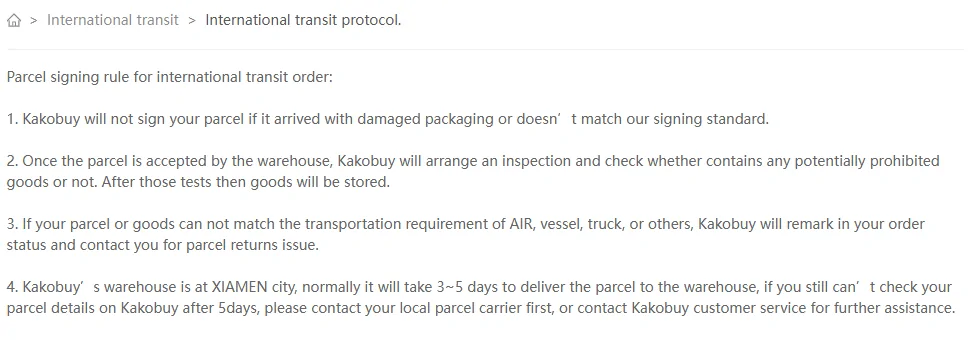
Signing is not the end of intake. Rule 2 says that once the warehouse accepts a parcel, Kakobuy arranges an inspection to check whether it contains any potentially prohibited goods, and only after those tests are the goods stored.
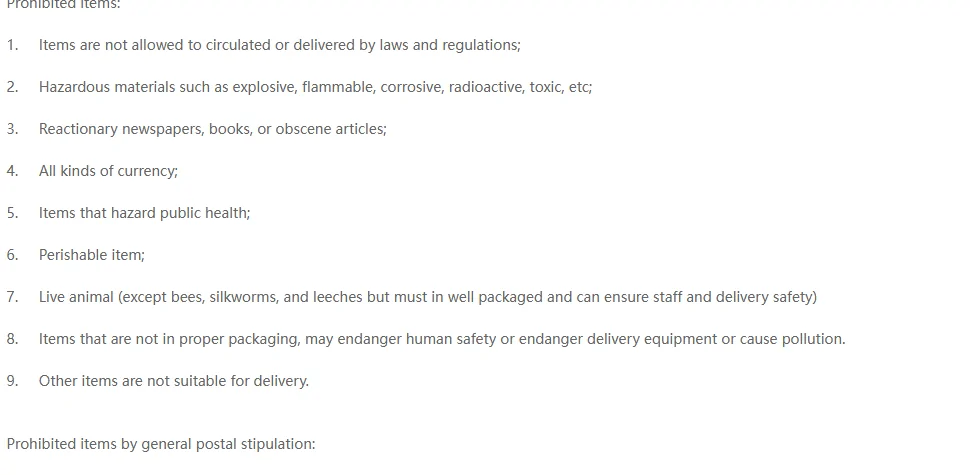
Help article 52 then prints three lists. The first is Kakobuy's own: goods barred by law, hazardous materials (explosive, flammable, corrosive, radioactive, toxic), all kinds of currency, items that harm public health, perishables, live animals with a narrow exception, badly packaged items that could injure people or damage equipment, and a catch-all for other unsuitable goods. The second repeats general postal rules, including sharp-edged or metal-buttoned packaging and anything banned at the destination. The third covers Taiwan's postal rules.
For a self-bought box, the practical point is that nobody at Kakobuy saw the listing before you paid. If a product description mentions a lithium cell, a pressurised can or a liquid, the warehouse finds out when it opens the box, which is later than you would want.
Air, sea and truck requirements, and the return remark
Rule 3 covers goods that are legal but cannot travel the way you planned. If a parcel or its goods cannot meet the transportation requirement of air, vessel, truck or other modes, Kakobuy writes a remark in your order status and contacts you about returning the parcel.
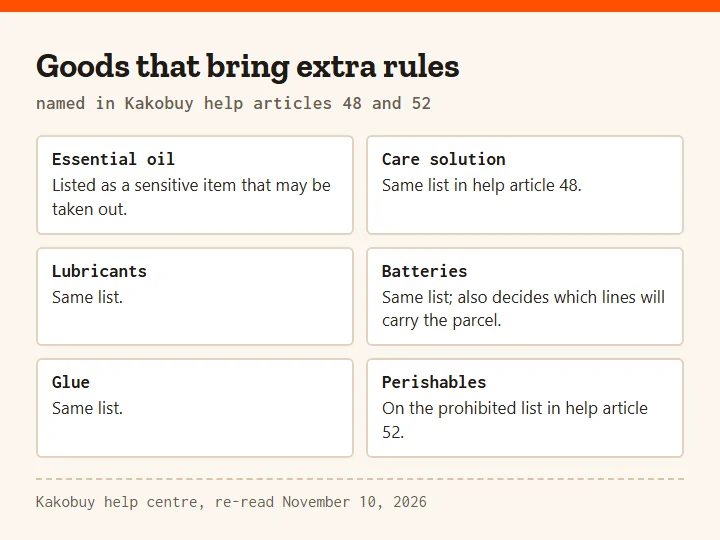
Help article 48, a disclaimer that covers both purchase orders and international transit, names the usual suspects. Items containing essential oil, care solution, lubricants, batteries, glue and other sensitive items may be taken out "to guarantee your delivery". Read literally, a box holding a phone case and a power bank could leave the warehouse without the power bank.
Help article 22 explains the knock-on effect at waybill time: goods that involve mailing restrictions are restricted when you submit the waybill, which is why two items stored side by side sometimes cannot be ticked together. The lines that do take batteries or liquids say so in their names on Kakobuy's estimator.
Counting, colour and size: the check itself
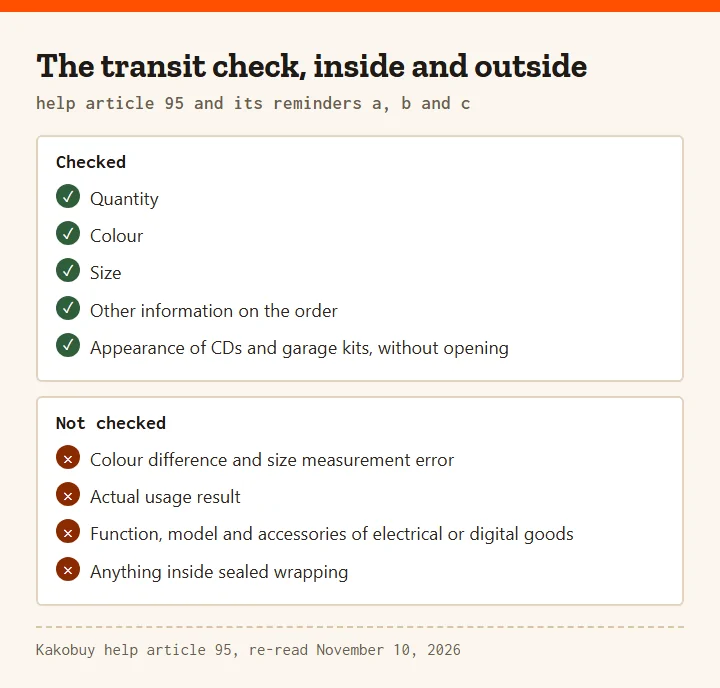
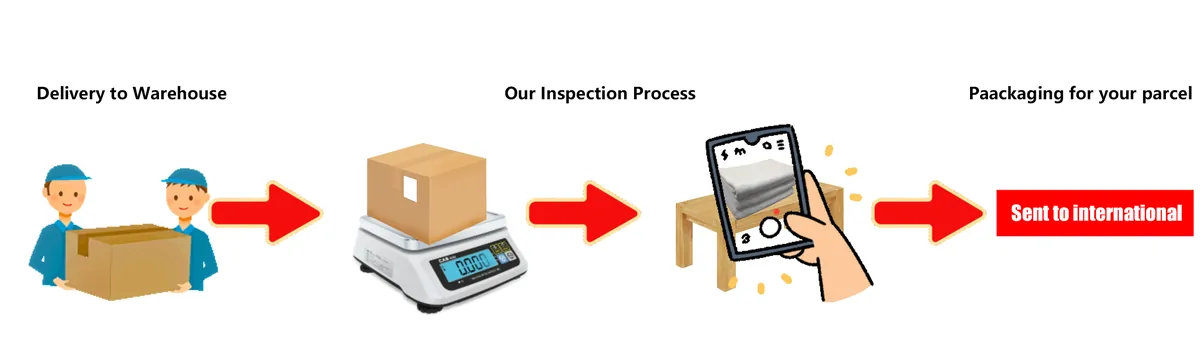
With signing and the prohibited-goods look done, help article 95 describes the inspection: Kakobuy checks the quantity, colour, size and other information of the goods. The reference point is your transfer order, which is why the remark and quantity fields deserve care. Three hoodies in two colours should be written as three pieces, with both colour names spelled the way the listing spells them.
The illustration below is Kakobuy's own picture of this stage from its shopping guide, drawn for purchase orders. For a transit parcel the yardstick is the information you declared: the article names quantity, colour and size, and says nothing about judging workmanship.
If the count is short or a colour is wrong, the warehouse's record is what you will show the seller. That is a strong reason to ship from a seller whose chat you can still reach and whose order page you have saved.
Seller packaging off, ziplock bag on
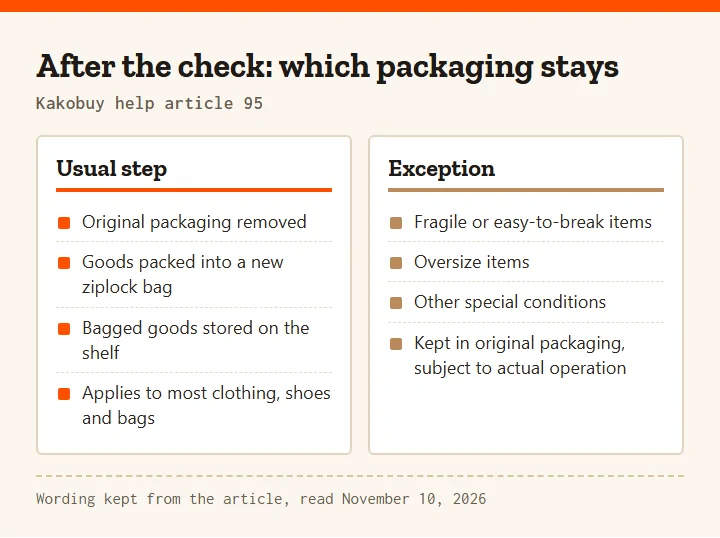
After the inspection, Kakobuy removes the original packaging and packs the goods into a new ziplock bag for storage. That is the default, and it matters if you care about the seller's box: shoe boxes, gift boxes and branded bags are packaging, and packaging comes off.
The exception is written in brackets in help article 95. For items which are fragile, easy to break, oversize or in another special condition, Kakobuy keeps the goods in original packaging, "but subject to actual operation". Read that last phrase as a warehouse decision, made at the shelf, not a promise you can rely on in advance.
Repacking also changes the weight you will be billed for later. A parcel that loses its shoe boxes in Xiamen may weigh less on the waybill than it did on the seller's label.
Outside the check: colour cast, gadgets, CDs and garage kits
Help article 95 ends with three reminders. First, the check leaves out how goods perform in use, colour difference and size measurement error. Second, for electric appliances, digital products, peripherals and other functional goods, quality, model and accessories are excluded. Third, for CDs, garage kits and similar goods, Kakobuy only checks the appearance without opening the wrapping.
For a transfer order that means three habits. Compare colours under your own light when the parcel arrives, not from the warehouse record. Test anything with a switch as soon as you unpack it, while the seller's return window is open. And keep sealed collectibles sealed until they reach you, since nobody has looked inside.
Purchase orders have a separate inspection article, help 89, which also limits the check to appearance, model, style and size. The two rules cover similar ground, but they are written for different counters.